Custom Quote Request
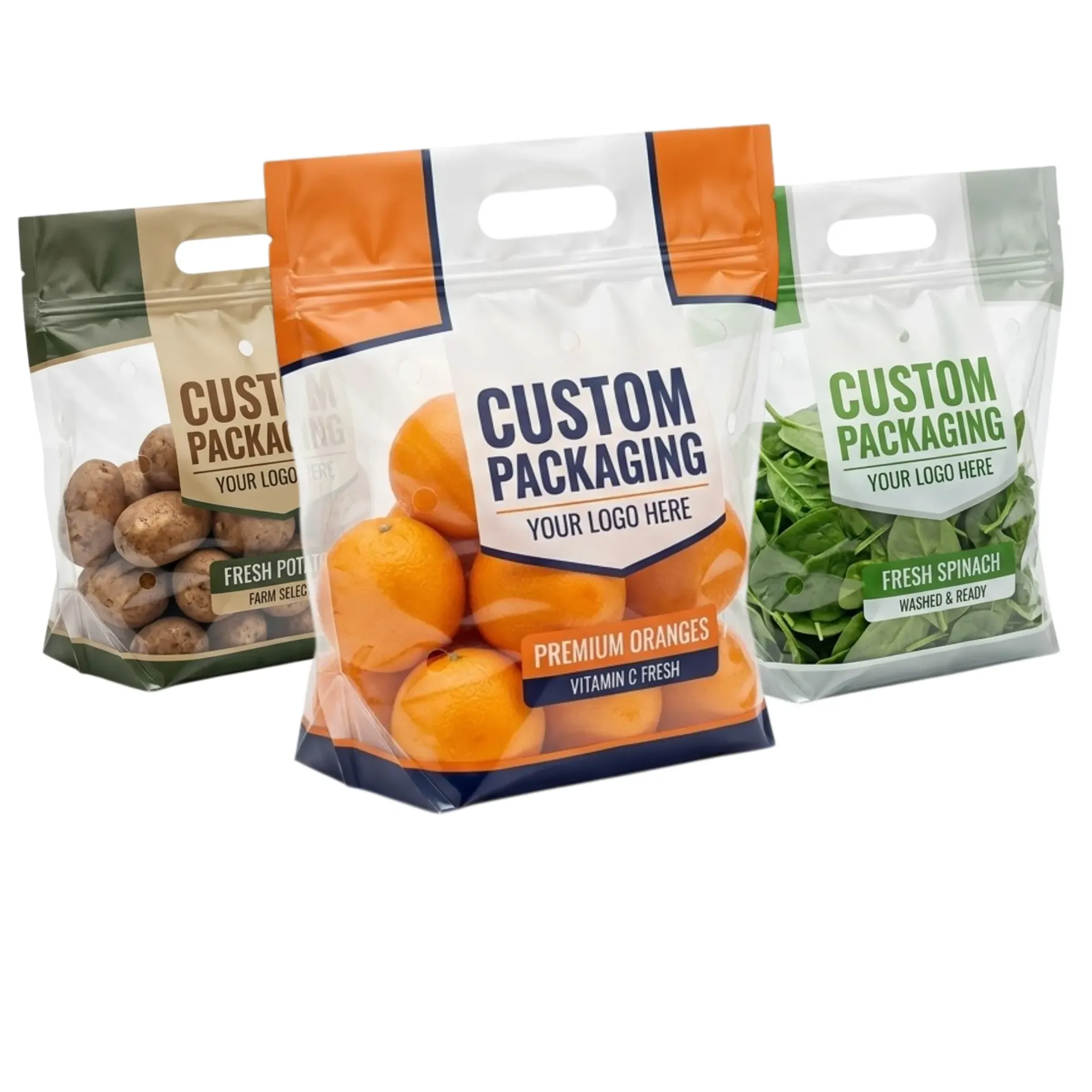
Custom‑printed produce packaging offers a
fresh, attractive way to present fruits and vegetables while strengthening your
brand presence. Designed to highlight product quality and display your logo or
messaging clearly, these bags and pouches keep produce protected, organized,
and visually appealing. With options tailored to different shapes, sizes, and
handling needs, custom produce packaging blends functionality with professional
branding—helping your products stand out in busy grocery aisles and farmers market
displays.
Build Your Spec:
Three choices, every combination available. The film, the vents and the print stay the same. What you choose is how it closes, whether it carries, and how it arrives:
| Choice | Options |
|---|
| Closure — how it recloses | Reclosable zipper · Slide seal · None |
| Handle — how it carries | Die-cut handle · No handle |
| Pack format — how it arrives | Flat packed · Saddle packed |
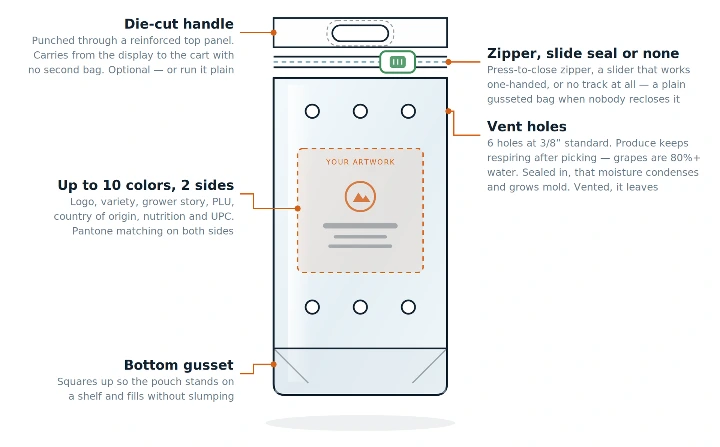
Produce is still breathing when you bag it. Every feature here follows from that.
Features:
- Up to 10 color printing on 2 sides - up to 10 colors, front and back, with pantone matching. Logo, variety name, grower story. PLU, country origin, nutrition panel and UPC all print on the same run.
- CPP/OPP laminated material - two films bonded together, each doing a different job. OPP on the outside carries the print and gives pouch its stiffness and gloss. It's the reason why a laminated pouch stands up on a shelf instead of slumping like a poly bag. CPP on the inside is the sealant and the moisture barrier; it's what makes a clean, reliable seal at the seams and the closure.
- Vent Hole - Produce is still alive after it's picked. It respires — takes in oxygen, gives off carbon dioxide and water vapor — and grapes are over 80% water. Seal that in solid film and moisture collects, condensation forms, and you get mold and soft fruit well before the sell-by date.
- Die-cut Handle - A handle punch through a reinforced top panel. On a 3lbs or 5lbs pouch, it's the difference between a customer carrying your bag to the cart and a customer asking for a second bag to carry it in. It also gives the pouch a place to hang if you merchandise it that way.
- Reclosable Zipper - a press-to-close track. Best when cost per bag matters and the pouch gets opened a handful of times.
- Slide Seal - a slider with a thumb grip that closes the track as it travels. Grapes and cherries usually run slide seal because the bag gets opened and closed a dozen times before it's empty.
- No Closure - a plain gusseted pouch, no track at all. This is the cheapest bag on the page by a wide margin, and it's the right answer more often than people assume: bulk and wholesale packs, anything that gets emptied into a bowl or a bin, anything with a short enough shelf life that nobody recloses it. Closes with a twist tie, a clip, tape or a heat seal.
- Flat Packed - loose stacks in a case. Simplest and cheapest; no header material to pay for. Right for a packing line with its own feed, or anywhere the pouches get loaded into a machine or filled at a bench.
- Saddle Packed - bundled on a punched header that hangs from a rack or wall arm. Pull one off and the bundle stays put. Right for hand-filling at a stand, a back room with no counter space, or a farmers market table.
Applications:
- Grapes — vented slide-seal pouch, 1 to 3 lb, usually with a handle at 3 lb
- Cherries and berries — vented, half-pint through 2 lb
- Cherry and grape tomatoes — snack size, zipper close, no handle
- Snap peas, green beans, Brussels sprouts — high respiration, more open vent area
- Salad and cut greens — clarity sells it; check whether the item wants micro-perf instead
- Apples, citrus, stone fruit — 3 to 5 lb, die-cut handle earns its cost here
- Mini peppers, radishes, baby carrots — printed pouches for a branded program
- Bulk and wholesale packs — plain gusseted, no closure, lowest cost per bag
- Farmers market and CSA — small runs, printed with a farm name
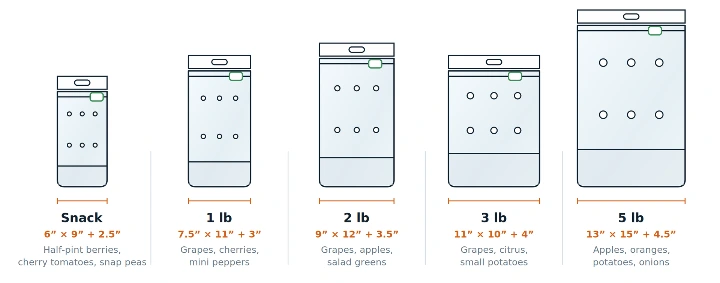
Drawn to scale. Dimensions are Width x Length + Bottom Gusset.
Sizes & Specs:
| Size | Dimensions (W x H + gusset) | Typical fill |
|---|
| Snack | 6" x 9" + 2.5" | Half-pint berries, cherry tomatoes, snap peas |
| 1 lb | 7.5" x 11" + 3" | Grapes, cherries, mini peppers |
| 2 lb | 9" x 12" + 3.5" | Grapes, apples, salad greens |
| 3 lb | 11" x 10" + 4" | Grapes, citrus, small potatoes |
| 5 lb | 13" x 15" + 4.5" | Apples, oranges, potatoes, onions |
Standard on every pouch
| Spec | Detail |
|---|
| Gauge | [2.5 mil] standard |
| Venting | [6] punched vent holes at [3/8"] — hole count and size adjustable by commodity |
| Print | Up to [10] colors, both sides, Pantone matching — or blank clear |
| Bottom | Gusseted |
| Compliance | FDA and USDA compliant for direct food contact |
FAQ
Why do produce bags have holes in them?
Because produce keeps respiring after it's picked — it gives off water vapor, and grapes are more than 80% water. In a sealed bag that moisture condenses, and condensation is what grows mold and softens fruit. Vent holes let it out so the inside of the bag stays dry enough to hold the product to its sell-by date.
Do I have to have a zipper?
No. A plain gusseted pouch with no closure is the cheapest option we run, and it's the right one for bulk packs, wholesale, or anything a customer empties in one go. Add a zipper or a slide seal only when someone is actually reclosing the bag.
Zipper or slide seal?
Zipper is cheaper and seals tight — good when cost per bag matters and the pouch gets opened a few times. Slide seal costs more but works one-handed, which is why grapes and cherries almost always run it: the customer opens that bag over and over.
Is the handle optional?
Yes. A die-cut handle is worth it at 3 lb and up, where the customer has to carry the bag from the display to the cart. Below that it's usually cost you don't need.
Vent holes or micro-perforation?
Vent holes are a handful of large punched holes — standard for grapes, berries, apples and most whole produce. Micro-perforation is thousands of sub-millimeter holes and is used where the item needs a more controlled exchange. If you're not sure which your commodity wants, tell us what you're packing and how long it has to hold.
Flat packed or saddle packed?
Flat packed is loose stacks in a case — cheapest, and right for machine feeding or bench filling. Saddle packed hangs from a punched header so you can pull one off with one hand — right for hand-filling where there's no counter space.
Can these go in the microwave?
No. These are vented pouches built to let produce breathe on a shelf, not to hold steam pressure or microwave heat. Steam-in-bag pouches are a different product with a pressure-release valve and a film rated for it. If that's what you need, ask us and we'll quote it separately.
Custom Quote Request